

What Languages of Love do You Speak?
- Feb 14, 2023
- 6 min read
Updated: Feb 17, 2023

What is Love?
“And now here is my secret, a very simple secret: It is only with the heart that one can see rightly; what is essential is invisible to the eye.”
― Antoine de Saint-Exupéry, The Little Prince
There is no doubt that love is one of the purest and most beautiful feelings one gets to experience in their lifetime. You end up finding it in the most unexpected places. Some love stories last, and others don’t. But what’s common is that it is a warm, fuzzy feeling that makes you giddy with joy. The best part is it is all around you; you just have to look for it not with your eyes but with your heart.
If I were to recall my earliest encounter with love, it is this vague memory of me as a tiny kid sitting on my mother’s lap, falling asleep while her warm arms were snuggly wrapped around my body, like a little caterpillar in a cocoon. I don’t remember the details; I just remember how safe and loved it made me feel. Since then, I have experienced love in many different ways. Be it my sister sharing the last piece of cake with me or my best friend randomly video-calling only to tell me that she values and loves me. There is also love in the perfectly round and soft besan laddoos my grandmother makes especially for me, and it is only out of love that I hug my friends before saying goodbye. While love helps you strengthen your bond, it doesn’t necessarily have to be verbal. On some nights, my youngest dog curls up next to me, rests her head on my ankle, and peacefully falls asleep. I can only wish to make her feel as safe and loved as my mom made me feel.

Science has its own way of explaining love, using ‘Chemistry.’ According to a study by Dr. Helen Fisher and her colleagues in 2002, romantic love can be divided into three overlapping categories: Lust, Attraction, and attachment. Each category involves a different interplay of hormones stemming from the brain.
1. Lust - Primarily motivated by the need for sexual gratification, the sex hormones estrogen and testosterone play a significant role here. Unlike common beliefs, both increase libido in males and females. The evolutionary underpinning for this is our urge to reproduce, which all living creatures share.
2. Attraction - While lust and attraction might not always co-exist, attraction is closely related to love. It involves a neurotransmitter called Dopamine, aka the ‘happy hormone,’ which, when released, makes us feel pleasure. It's interesting to note that this is very similar to how substance addiction works. Our brain craves this pleasure-inducing dopamine hit and, as a result, tries to reinforce behaviours that result in the same. This is why intense attraction feels like you're addicted to the other person.
Did you know that when we are in love or attracted to someone, our body assumes a state similar to stressful situations? So the butterflies that you feel or the sweaty palms, throbbing and thumping heart can all be attributed to the fight or flight hormone Norepinephrine. However, this is perceived as good stress as we associate it with happy things such as the sight, voice, or even smell of a loved one.
3. Attachment - The key player here is Oxytocin. It is released during skin-to-skin contact, which fosters a sense of security and contentment, further strengthening the connection. The hypothalamus releases oxytocin in greater doses during sex, childbirth, and breastfeeding: quintessentially, the preludes to forming a beautiful trusting bond.
As we now have a better understanding of standard chemical processes going on in the brain, it is essential to remember that falling and staying in love are very subjective experiences. We all think of love differently, bringing us to the next part of this blog.
What are the 7 Languages of Love?
Therapists cannot stress enough how most relationship issues are caused due to lack of communication of needs and how they can be resolved using effective dialogue. All brains are wired differently, and we have different experiences growing up. Because of this, different acts and gestures make different people feel loved, appreciated, and valued. What works for you is your love language. It is important to remember that two people might not have the same love language. Hence partners must communicate which of the seven languages makes them feel special. Going out of your way to appreciate your loved one the way they like to be appreciated or learning to speak their love language will go a long way in strengthening the relationship. This is true not only for romantic relationships but also for platonic ones. The following are the seven languages of love:
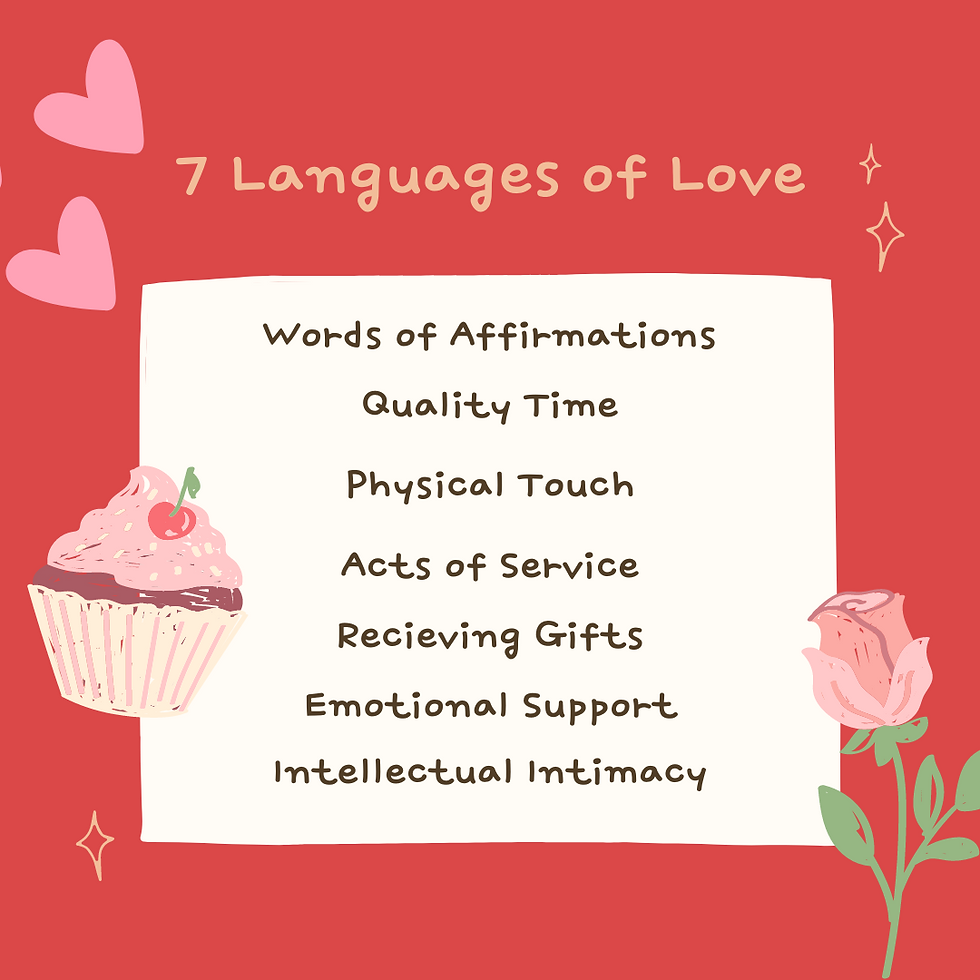
Words of Affirmation
This involves expressing affection using words. A person whose primary love language is words of affirmation will want to be praised, complimented, and appreciated using spoken words. Constant reassurances in the form of "You look so beautiful today," "Your presentation went really well, I am proud of you," or even a simple "I love you" will be really helpful. Such people will also enjoy cute messages on post-its, love letters, and even sweet text messages when you are away from them.
Quality Time
This is about spending time with your loved ones and ensuring they have your undivided and complete attention. You could go out on dates, plan hikes, or even spend a day at home sipping coffee and talking about life. All that's important is you let them know that they matter to you by taking out time to spend with them. Maintaining eye contact, not attending calls, not scrolling through Instagram, and even active listening can be effective tools.
Physical Touch
Many people find comfort and love in physical touch, which doesn’t necessarily have to be sexual. This is expressed through giving out bear hugs, resting your head on someone’s shoulder, the occasional reassuring pat on the back, a gentle arm rub, or even high-fives after lame jokes. A person whose primary love language is this finds comfort in physical affection and reassurance in casual touch.
Acts of Service
Do you feel loved when someone helps you with little tasks on a busy day? If yes, then maybe ‘Acts of service’ is your love language. You express your love by doing chores: washing dishes or cooking together. Even tiny things like folding your loved one’s blanket or even switching on the fan when they are too lazy to get up could speak volumes. If this sounds like you, then you can appreciate their love more through their service and kindness directed towards you.
Receiving Gifts
If you ever find yourself saving tiny significant presents gifted by people who matter to you, then maybe ‘receiving gifts’ could be your love language. In this, people express their affection by giving gifts and feel loved and valued when they receive one. This does not necessarily mean expensive gifts; it could be something as simple as a stupid doodle or a wildflower your loved one plucked for you. The gift symbolizes how well they know you and shows that they are willing to put in the time and effort to make you feel special by picking out something that you would love.
Emotional Support
When a loved one can relate to you and help you through difficult feelings, people who speak the ‘emotional’ love language feel valued and cared for. This places more emphasis on a connection on an emotional level than a physical one. When they receive compassionate support through emotionally draining, painful, or vulnerable moments, this kind feels loved. It shows a strong sense of willingness to stick through thick and thin.
Intellectual Intimacy
People that speak the intellectual love language prefer to communicate intellectually. When a loved one appreciates their knowledge, respects their perspective, and engages in intelligent conversation about significant matters, they feel cherished. While the want to spend quality time together is present, its primary emphasis is on intellectual compatibility and respect for one another's intelligence, opinions, and skill. This could include having similar views on religion, politics, feminism, and the ideal way of raising kids to something as banal as how one likes their coffee.

Coming to the conclusion: love is complex, stupid, and infinite. Sometimes love hurts, but above everything, it sustains; hence it is crucial for human survival. With so much love going around, it is impossible not to experience it. Even when getting hurt is inevitable, it makes more sense to cherish every second of it for as long as it lasts. So while figuring your way around it, why not learn to love better?
References
BBC. (2022, June 20). What is love from a neuroscientific perspective? BBC [Video]. YouTube. https://www.youtube.com/watch?v=18Y68XN96XM
Chapman, G. (2005). The Five Love Languages: How to Express Heartfelt Commitment to Your Mate.
Fisher, H. L., Aron, A., Mashek, D., Li, H., & Brown, L. L. (2002). Defining the brain systems of lust, romantic attraction, and attachment. Archives of Sexual Behavior, 31(5), 413–419. https://doi.org/10.1023/a:1019888024255
Gordon, S. (2023, February 8). What Are the Five Love Languages? Verywell Mind. https://www.verywellmind.com/can-the-five-love-languages-help-your-relationship-4783538#toc-the-five-love-languages
Garrison, N. (2023, January 23). The Five Original + The Seven New Love Languages. Claibourne Counseling. https://claibournecounseling.com/love-languages/
The Seven Love Styles. (2022, May 16). Truity. https://www.truity.com/page/seven-love-styles#:~:text=People%20with%20the%20Emotional%20love,as%20opposed%20to%20physical%2C%20connection.

-01.jpeg)
A very well written and articulated thought on love that everyone should read.