

What Is Your Stomach Telling You?
- Jul 17, 2023
- 5 min read
Would you believe me if I said that your stomach can actually talk to you? We as humans often feel and store emotions physically. Be it churning of the stomach when you are scared, tension in the shoulders, or clenching of the jaw when you are angry. While a lot of people report similar experiences of physiological reactions to certain emotions, it could also be completely unique.
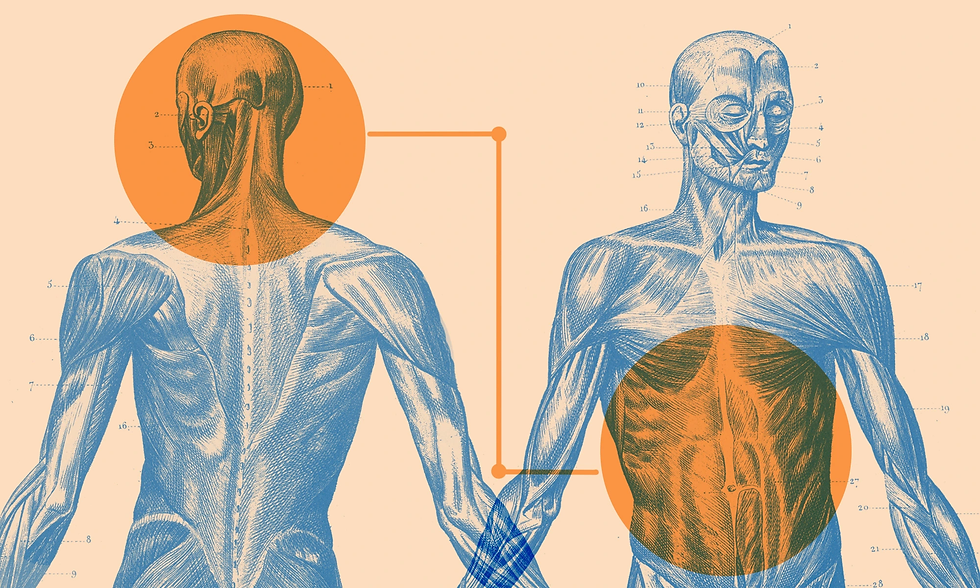
Illustration by: Sacha Vega/iStock
A 2014 study about ‘Bodily maps of Emotions’ states that somatosensory cues have evolved over millions of generations and vary very little across cultures. For example, when we are angry, nervous, or surprised, our heartbeat intensifies in preparation for flight or fight. In rage, the muscles of our arms and legs become clenched, but they go limp when we are sad. The study further revealed that we feel a wide range of emotions such as happiness, fear, anger, disgust, anxiety, and love in our stomach. They also concluded that not feeling certain emotions where we normally do could thus provide a novel biomarker for emotional disorders like anxiety and depression (Nummenmaa et al., 2014).
Similarly here are some lesser-known facts about our tummy that I recently learned and could not keep in my stomach:
When logic fails, do you trust your gut?
A Gut feeling is a sudden sensation based on a quick emotional intuition rather than deliberate thought. And while we think it is not quite logical, it in fact does have a solid scientific explanation. What if I told you there is a ‘second brain in your gut’? Also known as the Enteric Nervous System or ENS. It is made up of two thin layers of around 100 million nerve cells (more than the ones found in the spinal cord) that line the GI tract from the esophagus to the anus. This is revolutionising medicine's knowledge of the links between digestion, mood, health, and even the way we think as we now know our gut is capable of doing much more than processing the food we eat.

When you approach a decision instinctively, your brain and gut work together to swiftly examine all of your memories, previous learnings, individual needs, and preferences, and then make the best decision given the circumstances. In this sense, intuition is a type of emotional and sensory input that one must respect. Even if you don't actively use your intuition, you probably benefit from it every day and it keeps you away from danger.
However, you should be able to differentiate between your gut feeling and anxious thoughts. A therapist could help you with this. A gut feeling normally helps you make concrete and quick decisions especially when there is a lack of evidence. Anxious thoughts, however, are often about your future, are distressing and further cloud your judgment.
All in all, you should definitely pay close attention to your gut feelings. In fact, there is a lot of research being done to study the benefits of following one’s intuition and incorporating it into business and defense training.
The feelings we Stomach
Have you ever had a loss of appetite or abdominal pain when you feel anxious or stressed? Perhaps you've had "butterflies in your stomach" when you see someone you secretly like or when you're nervous or excited? You might also feel queasy or a pit in your stomach when you are scared, and pukish when you feel disgusted. This is all due to the ENS or gut-brain axis, which connects the brain with the gut.

Our gut health can have an impact on our mental and emotional well-being. Trillions of different bacteria live in our gut and play an important role in digestion and metabolism. They digest food and generate vitamins that the body absorbs and utilizes. Certain micro-organisms are also involved in the production of neurotransmitters, which are chemical molecules essential for the body’s normal functioning.

Among many others, the gut produces two types of neurotransmitters: Serotonin and Dopamine, a lack of both is linked with Depression. In fact, the gut stores 90-95% of serotonin and 50% of dopamine in our bodies. Infections or damage to our gut lining caused by irritable bowel syndrome, diarrhea, or asthma, might result in an imbalance of "good" and "bad" micro-organisms in our stomach. This imbalance can in turn cause or foster irritable bowel syndrome, Anxiety, and Depression (Lin, 2023). Thus incorporating natural probiotics like curd, kefir, cheese, leafy green vegetables, and fruits in our diet is crucial and can actually help regulate our mood.
Interestingly, anti-depressants known as selective serotonin reuptake inhibitors (SSRIs) enhance serotonin levels to curb depression. It's no surprise that medications designed to create chemical changes in the brain frequently cause GI difficulties as a side effect. Irritable bowel syndrome is similarly caused by too much serotonin in our intestines and may be considered a "mental illness" of the second brain (Hadhazy, 2010).
Maybe your chronic acidity has more to do with your emotions than last night’s Rajma Chawal?

Anxiety and stress often cause GI symptoms such as abdominal pain, bloating, constipation, or diarrhea (Lin, 2023). Anxiety may cause the lower esophageal sphincter to relax abnormally, causing stomach acid to flow back up through the esophagus, causing heartburn and upper abdominal pain. Stress caused by anxiety may also affect contractions occurring in the esophagus, which propel food toward the stomach. If these contractions become irregular, it can lead to reflux (Seidholz, 2021). Finally, high stress and anxiety levels may increase the production of stomach acid, and the protective layer of mucus on the lining is broken down, which makes it more susceptible to damage and the formation of ulcers and could lead to stress-induced gastritis (Megha, 2023).
Are you HAngry?

When your stomach is rumbling, you're more inclined to unexpectedly lash out at people around you. That abrupt, irrational rage is commonly referred to as being ‘Hangry’ (a mix of hunger and anger), a condition that is extremely real. When we are hungry our blood sugar drops, and our body releases the hormone adrenaline to restore normal glucose levels. This is also known as the fight-or-flight response, in which the body prepares us to deal with danger. However, when there is no threat present, we may get angry or irritated as a result of all that additional energy that cannot be used (Naftulin, 2022).
-------------------------It is so interesting to see how our emotions are closely related to and have the capacity to cause physiological changes in our body and vice-versa. Taking into account all the aforementioned information, maybe our mums were right all along, the best way to someone’s heart is through their stomach. This is exactly why one should pay close attention to what our stomach is trying to tell us. After all, happy gut, happy life.
So, is your stomach trying to tell you something?
References
-Rayole, S. (2021, January 27). Gut feelings are real, but should you really ‘Trust your gut’? Healthline. https://www.healthline.com/health/mental-health/trust-your-gut
-Hadhazy, A. (2010, February 12). Think twice: How the gut’s “Second brain” influences Mood and Well-Being. Scientific American. https://www.scientificamerican.com/article/gut-second-brain/
-Lin, S. L. M. R. (2023, March 21). 4 Tips to Support the Gut-Brain Connection and Improve your Gut Health. foodsmart. Retrieved July 16, 2023, from https://www.foodsmart.com/blog/the-gut-brain-connection-and-ways-to-support-it#:~:text=Serotonin%20and%20dopamine%20are%20two,%2C%20behavior%2C%20and%20neurological%20functions.
-Lv, H., Zhao, Y., Chen, J., Wang, D., & Chen, H. (2019). Vagus Nerve Stimulation for Depression: A Systematic Review. Frontiers in Psychology, 10. https://doi.org/10.3389/fpsyg.2019.00064
-Megha, R. (2023, April 16). Stress-Induced gastritis. StatPearls - NCBI Bookshelf. https://www.ncbi.nlm.nih.gov/books/NBK499926/#:~:text=Symptoms%20include%20upper%20abdominal%20pain,it%20more%20susceptible%20to%20damage
-Naftulin, J. (2022, December 27). What is ‘Hangry’? Feeling angry after not eating is a real thing. Health. https://www.health.com/nutrition/what-is-hangry#:~:text=Ever%20notice%20how%20you're,is%20a%20very%20real%20thing.
-Nummenmaa, L., Glerean, E., Hari, R., & Hietanen, J. K. (2013). Bodily maps of emotions. Proceedings of the National Academy of Sciences, 111(2), 646–651. https://doi.org/10.1073/pnas.1321664111
-Seidholz, M. (2021, December 6). Does anxiety cause acid reflux? EverydayHealth.com. https://www.everydayhealth.com/gerd/symptoms/connection-between-anxiety-acid-reflux/#:~:text=Stress%20caused%20by%20anxiety%20may,the%20production%20of%20stomach%20acid.


-01.jpeg)
It's structured so well, it's beautiful. The yogic system of food habits and the aasans is thoroughly questioned by westerners and Indians alike, like why is it so rigid, how can an aasan that is related to back improve my mood, why should we eat less than the hunger. And the simple answer to that is to develop the gut intelligence, or infact, intelligence throughout the human body and also so that the body releases the right hormones in the right quantity. Really enjoyed reading it :')
Rahul